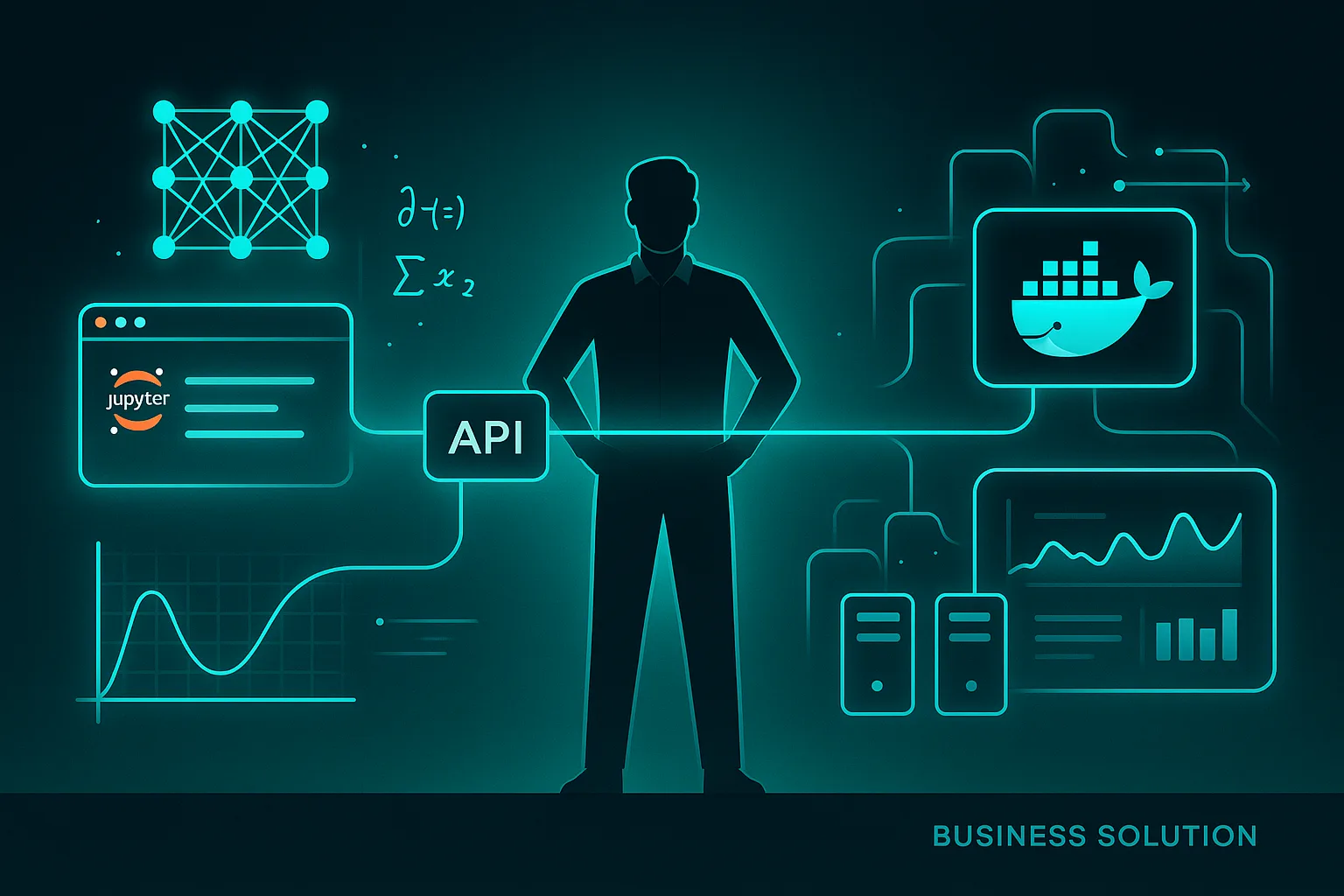
Every aspiring AI/ML engineer starts by learning to build models: classification, regression, computer vision, NLP-you name it. But here’s the hard truth: clients and employers don’t pay for models in a notebook. They pay for solutions that work in production, scale with users, and integrate with business workflows.
That’s where MLOps (Machine Learning Operations) comes in. If you want to stand out in a competitive market and land high-value projects, learning deployment, automation, and monitoring is no longer optional-it’s the differentiator that gets you hired.
Why Clients Care About Deployment, Not Just Models
- A churn prediction model in a notebook doesn’t reduce churn-an automated pipeline that scores users daily and sends insights to a CRM does.
- A computer vision model that detects defects in test images is nice, but a real-time API that integrates into a factory’s workflow saves millions.
- NLP sentiment analysis sitting in a Jupyter notebook is interesting, but embedding it into a customer support dashboard transforms decision making.
The Missing Skill Most AI/ML Engineers Ignore
Most engineers stop at model.fit(). They know PyTorch, TensorFlow, scikit-learn-but when a client asks: “Can you deploy this so my team can use it tomorrow?” they freeze.
Employers are hungry for engineers who can bridge this gap. If you can confidently say: “Yes, I’ll build your model AND deploy it to AWS/GCP with an API, CI/CD, and monitoring”, you instantly become more valuable than 90% of the competition.
Frameworks & Tools to Master for Client Projects
- FastAPI: The go-to framework for turning models into APIs with validation, async performance, and auto docs.
- Django: Perfect when a client needs a full product (dashboards, user logins, admin panel) around the ML model.
- Docker: Standard for containerizing ML apps to run anywhere.
- CI/CD (GitHub Actions, GitLab CI): Automates model updates and deployment pipelines.
- Cloud Platforms (AWS SageMaker, GCP Vertex AI, Azure ML): Clients want scalable, reliable deployments-not scripts on your laptop.
- Monitoring Tools (Prometheus, Grafana, MLflow): Track model performance drift and system health in production.
Real-World Client Example
Imagine a retail client hires you to build a demand forecasting model. Here’s how an “average” ML engineer approaches it vs. how a future-proof ML engineer delivers impact:
| Average Engineer | Future-Proof Engineer |
|---|---|
| Trains a forecasting model in Jupyter Notebook and emails the notebook. | Builds forecasting API with FastAPI, deploys on AWS with Docker, integrates results into client’s ERP system, adds monitoring for drift. |
| Client struggles to use results, asks for multiple manual exports. | Client gets real-time insights via API, automated daily reports, and confidence in reliability. |
Career Impact: Why This Gets You Hired
When clients or employers evaluate candidates, they’re not just thinking: “Can this person build a model?” They’re asking: “Can this person deliver a business solution end-to-end?”
By showing expertise in MLOps and deployment frameworks like FastAPI, Docker, and cloud services, you prove that you can deliverproduction-ready AI-and that’s what companies pay for.
Final Thoughts
The AI/ML job market is crowded, but most engineers are stuck in the “model-only” stage. If you want to stand out to clients, you must master deployment, automation, and monitoring. That’s where true business value lies.
Learn to take models from Jupyter to production, and you won’t just get hired-you’ll be the engineer clients fight over.
Found this useful?
Pass it on to someone who needs it.